

What is the Left?
Part I: The Making of a Political Tradition, Universalism and Revolution

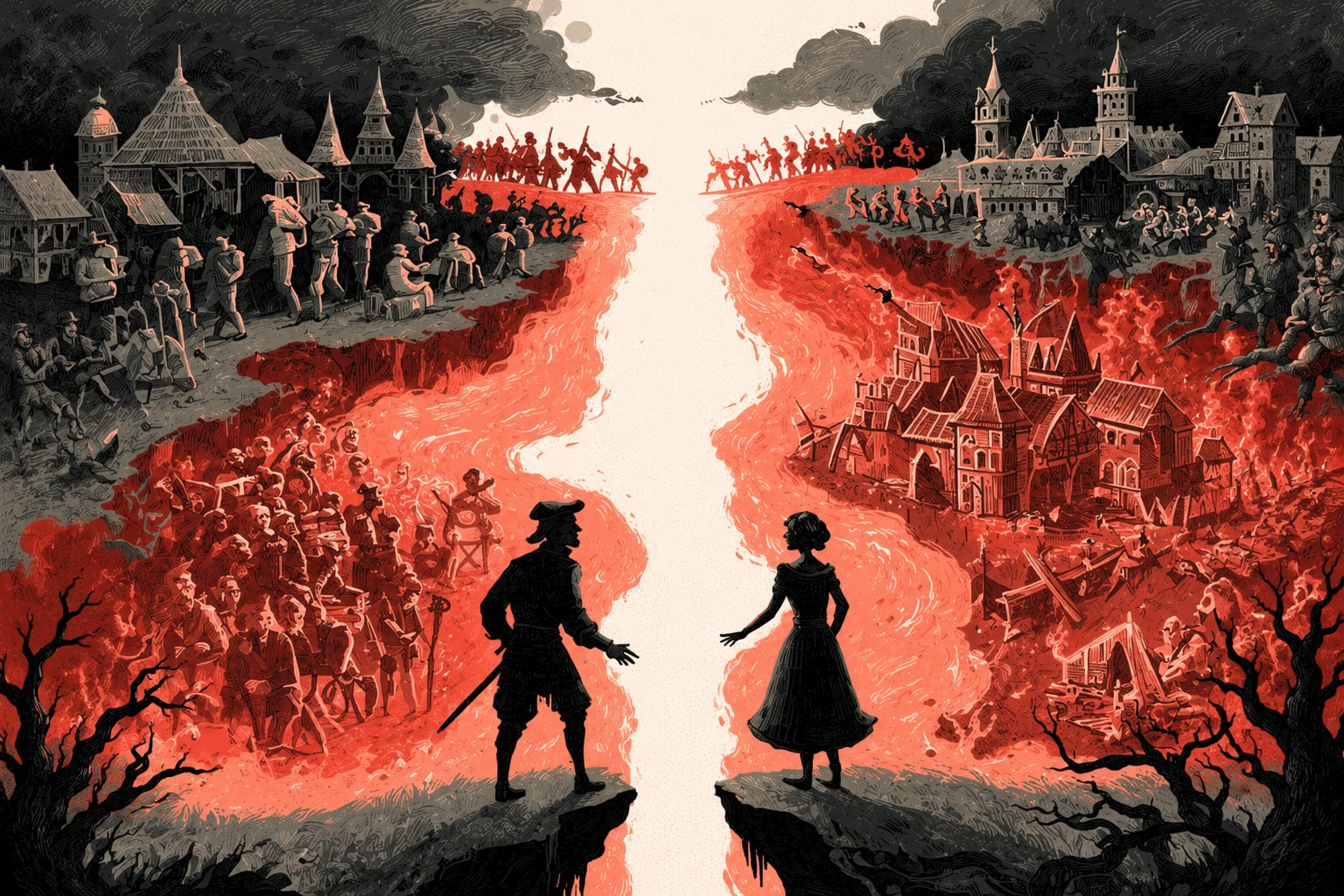
This essay is the first in a series examining the history of the political Left and its relationship with Jews, Judaism and Israel. Before any of those subjects can be addressed it is necessary to begin with a deceptively simple question: What is the Left?
The Left is often invoked as though it were a self-evident category requiring no definition beyond a loose collection of parties, movements or policy preferences. That may be sufficient for “political junkie” podcasts and fast contemporary commentary, but it is inadequate for this analysis. The meaning of the Left shifts across different historical periods and national contexts. Yet beneath these changes it has retained a number of enduring principles that give the tradition its coherence.
The use of the term Left derives from the French Estates General of 1789, where the nobility sat to the king’s right and representatives of the Third Estate to his left. Reflecting this institutional origin, the French lexicographer Émile Littré defined the Left as “the opposition party in French parliaments.” Under such a definition, the Left is understood primarily by its position in relation to power: it is the party of opposition.
This definition quickly proves inadequate for reasons obvious to all. Today, political parties alternate between government and opposition, but a left-wing party does not cease to be left-wing because they enter office.
Along with the term Left, we are bound to encounter the Right. These two terms are applied to factions and opinions within every political order, largely expressed in polar opposite to one another. The resulting picture of our politics is therefore spread in a single dimension or spectrum. The words Left and Right have long been used to denote the most recent struggle between the oppression of the old and the coming of the modern, especially in regard to moneyed interests.
We’ve long wanted to believe that the Left stood out for the distance it put between itself and powerful interests. That the Left understands itself as the champion of the oppressed and the adversary of domination. Where earlier generations confronted kings, aristocrats and feudal privilege, the contemporary Left casts multinational corporations, concentrated wealth and entrenched economic power as their modern equivalents. In this self-conception, history is understood as a recurring struggle between those who possess power and those subjected to it. To ask adherents of the Left what it means to be left-wing is therefore almost invariably to encounter some variation of the same answer: that the Left exists to advance the interests of ordinary people against systems of oppression and injustice. We are therefore to take from such an answer that the cause of the Left is the cause of the decent, everywhere.
But the twentieth century taught us that this is not always the case, especially not at the extreme’s. If we take Bolshevism and Spanish Fascism, there is little hesitation in describing the former as left-wing and the latter as right-wing according to both its process of attaining power and its principles.
Bolshevism displaced the old ruling class, abolished private ownership of the means of production and came to power through workers, peasants and soldiers demanding justice. Spanish Fascism, by contrast, overthrew a parliamentary regime, drew its principal support from the privileged classes, and secured victory in the Civil War with the assistance of colonial troops and German and Italian intervention. The contrast appears equally sharp at the level of ideas. Bolshevism invoked rationalism, progress and liberty. Franco appealed to family, religion and authority. Almost nothing here draws us away from the struggle between the old and the modern.
The difficulty is that this antithesis does not survive every historical case. National Socialism mobilized millions who were no less impoverished than those drawn to the German Communist parties. Hitler was indeed financed by bankers and industrialists, and many military leaders regarded him as Germany’s best hope for national restoration. Yet millions of Germans followed him because they had lost faith in elections, political parties and parliamentary government. Among his supporters were debt-ridden peasants, unemployed workers and countless disillusioned intellectuals who regarded liberals, plutocrats and social democrats alike as defenders of the existing order benefitting from the status quo.
As the Nazi regime consolidated power, it increasingly subordinated traditional elites to the state. Aristocratic military leaders were executed alongside social democrats. The economy was progressively brought under state direction, while the Nazi Party sought to reshape Germany, and ultimately Europe, in accordance with its own ideological vision. In its identification of the Party with the State, its transformation of a minority doctrine into a national orthodoxy, and its reliance on terror and unrestricted police power, Hitler’s regime bore striking similarities to Soviet Russia.
It may be argued that Hitlerian totalitarianism remained fundamentally right-wing because it derived its inspiration from counter-revolutionary romanticism, while Stalinism remained left-wing because it emerged from revolutionary rationalism. Yet within a generation of the October Revolution, the Soviet Union extolled Russian nationalism, denounced cosmopolitanism and preserved the full apparatus of the police state. In doing so, it repudiated many of the values that the Enlightenment had sought to defend against arbitrary power and religious obscurantism.
The point here is not that Left and Right are identical. It is that at the extremes, Right and Left appear to converge in totalitarianism and the relationship between the old and the modern or oppression versus oppressed is nearly non-existent. Such a principle should not be too hard to grasp, the opposite of religious fundamentalism is not militant atheism but indifference to the existence or non-existence of God. The spectrum is therefore not linear and hence provides no meaningful understanding for our question.
If the Left cannot be defined simply by its parliamentary position, nor by its opposition to the Right, then it must refer to something deeper: a distinctive conception of politics, society and history that persists across changes in governments, parties and even political regimes.
Throughout this series, I shall argue that two interweaving principles are indispensable to understanding the Left, even if they are not exhaustive. The first is universalism. The second is revolution. Together they illustrate an enduring outlook on the world that has been a permanent feature of Western civilization and the Left at least since the Enlightenment, nourished by the elaborate social and political theories that I shall discuss in what follows.
For the purposes of this essay I would like to only lay the foundations first by showing that universalism has two faces to the world: an emancipatory face that looks to the inclusion of the ‘Other’ on the assumption that the they too are a human being like anyone else, but also a repressive face that sees in the ‘Other’ a failure to pass some fundamental test of what is required for membership of humanity. This is why the Left’s self-conception as the party of the oppressed, but never the oppressor, fails even the slightest scrutiny.
What we can already say is that supporters and opponents of universalism both capture something real and important about the phenomenon itself. Supporters remind us of universalism’s emancipatory content: that it has proven to be a vital principle of civil, political and social inclusion. Opponents focus on universalism’s dark side: that it has been used as a means of stigmatizing, excluding and at times eliminating the ‘Other’.
In its emancipatory aspect, the principle of universalism entails a treaty of ends: to see all human beings as human beings regardless of their particular differences; to translate the abstract conception of humanity into practical legal, political and social consequences; to challenge the legitimacy of all forms of exclusion; to understand the particular differences we construct and with which we may identify — such as class, ethnicity, gender, sexuality, nationality, and religion — as relative to an inherently diverse humanity; and not least to acknowledge the singularity of every individual human being. The progress of humanity according to this application of universalism is self-evident.
In its repressive aspect the principle of universalism serves to represent whole categories of people as inhuman, or not fully human, or not yet human, or more specifically, in the language of Roman Law, as ‘enemies of the human species’ (hostis generis humani). Many different categories of people have been turned into ‘others’ in analogous ways, including the enslaved, the colonized, the exploited, the orientalized and those simply labelled deviant.
Jewish experiences of universalism have been correspondingly equivocal. Universalism has acted as a stimulus for Jewish emancipation, that is, for civil, political and social inclusion; it has also been a source of anti-Jewish prejudice up to and beyond the classic antisemitism of modernity and antizionism of the second half of the twentieth century till today.
One of the peculiarities of the universalist tradition has been to represent Jews in some important symbolic regard as the ‘other’ of the universal, the point from which meaning and belonging can be stimulated: as the personification either of a particularism opposed to the universal, or of a false universalism concealing Jewish self-interest. The former contrasted the particularism of the Jews to the universality of bourgeois civil society; the latter contrasted the bad universalism of the ‘rootless cosmopolitan Jew’ to the good universalism of whatever universal is advanced – be it the nation, the race or the class.
It is this negative face of universalism that has shaped what was commonly called ‘the Jewish question’. The struggle between Jewish emancipation and the Jewish question has been a struggle waged over the spirit of universalism itself and will be the topic of the next essay.
If universalism, in the positive and negative, provides the moral horizon of the Left, revolution provides one the primary means by which that horizon is to be realized. The relationship between the two is not accidental: universalism begins with the conviction that humanity ought to exist according to a common standard. Revolution begins with the judgement that existing institutions prevent that ideal from being realized. The ancien régime, capitalism, imperialism, colonialism or any number of inherited social arrangements cease to appear as merely corrupted political orders, and instead become historical obstacles standing in the way of humanity itself.
Revolution, in this sense, is not simply the violent seizure of power. It is a philosophy of history that rests upon the belief that the existing order derives neither its legitimacy nor its permanence from tradition, but from contingent historical circumstances that can, and ought, to be overturned. The purpose of revolution is therefore not merely to replace one government with another, but to bring about a political reality into conformity with a universal ideal.
Even as the object of universal emancipation has shifted — from the Rights of Man, to the proletariat, to the colonized world, and more recently to new conceptions of social justice — the revolutionary impulse has remained with it. Each revolutionary project identifies a particular institution, class or people as the obstacle to humanity’s emancipation, and therefore as the object that history must overcome. It is ultimately this relationship that has produced a reality in which the revolution, despite its moralist aspirations has turned the present human being into sacrifices of an imagined, glorious future. We can indeed point to the Reign of Terror in 1789, the Gulags after 1917 or the barbarism of Mao’s Cultural revolution. None of these are accidental deviations, but inherent logics of such ideological visions.
In returning to the question with which this essay began: the Left clearly cannot be defined by parliamentary seating arrangements, by opposition to the Right, or by any particular policy program. Its unity lies instead in a distinctive understanding of history. It is a tradition animated by the universal aspiration to human emancipation and by the revolutionary conviction that history can be remade to achieve it. Whether those aspirations have produced liberation or oppression is another question. That they have provided the enduring grammar of the political Left is the premise from which the remainder of this series proceeds. These two concepts are key to understanding universalism and its encounter with the Jewish question, the relationship between Israel and the Old Left, the emergence of Zionism and antizionism as an object of the New Left, and the competing revolutionary visions of Arab Marxism and Zionist Socialism in the Middle East.
“philosophy of history that rests upon the belief that the existing order derives neither its legitimacy nor its permanence from tradition, but from contingent historical circumstances that can, and ought, to be overturned.”
And thus, you nail the entire political function of Marxists historical determinism to the door.
Excellent beginning. Defining terms before drawing conclusions is rarer than it should be. I’m very interested to see where this framework leads, particularly when you turn to the Jewish question and Israel. That’s where a historical framework has the opportunity to demonstrate its explanatory power.