

Jesus is Palestinian, Decolonizing the Bible
The effort to destroy Israel for the salvation of man.

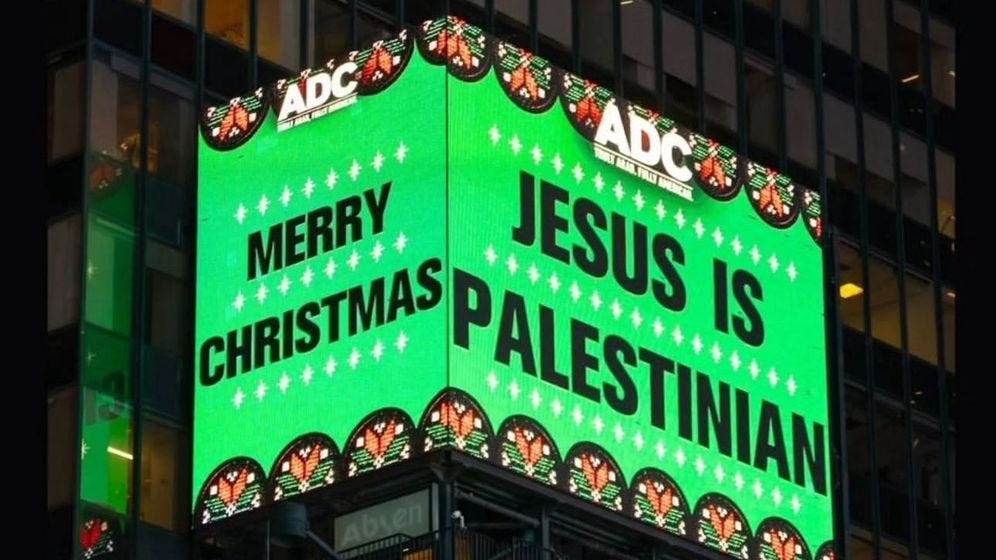
Jesus is Palestinian. The verb is reveals all. In theology - is - generally does not seek describe something or someone; it declares eternal existence and the path to salvation. “This is my body”, “I am the way.”
To say Jesus is Palestinian is then not merely making a claim about the identity of a historical figure. Nor is it principally an attempt to write the Jews out of their own story, though that is certainly one of its dominant premises. The project is far more ambitious and far more dangerous. It seeks to relocate the meaning of salvation itself within the idea of the Palestinian cause.
For that reason, there is little point arguing with activists in the West about whether Jesus was a Jew born in Judea under Roman occupation. That they know this, deny it, or simply regard it as irrelevant is precisely the point. The problem is something deeper than historical ignorance, it is an effort to transform a contemporary political cause into a theological category, to elevate Palestine from a place and a people into a redemptive principle through which the biblical story itself must now be read.
There are two particular works I would like to point to that reveal precisely this ambition, both of which I, as a secularist and a Jew, somehow anointed myself to the great misfortune of recently finishing. Whatever your views on religion may be, I encourage my readers to do the same. It will be a revelation!
Before proceeding, it is worth asking what the task of a theologian actually is. The theologian’s vocation is of course not to remake God in the image of a political cause. It is to wrestle with revelation, preserve the integrity of a religious tradition, and illuminate the relationship between the human and the divine. Theology may speak to politics, but it ceases to be theology when revelation becomes merely a vehicle for ideology. For centuries, theologians have sought to understand how eternal truths bear upon temporal affairs. They have not sought to subordinate the eternal to the political demands of the political moment.
The first work is by Mitri Raheb, a Palestinian-Christian theologian, who offers us this project in his 2023 book Decolonizing Palestine: The Land, the People, the Bible. Raheb invites Christians in the West to see the Bible not as the Jewish book of origins that proceeded Christianity, but as a weapon forged by “Zionist colonizers against indigenous Palestinians.”
It is difficult to miss that Raheb has spent more time absorbing the lessons of Edward Said than the scriptures. For him, “the traditional reading of the Bible” is a classic example of “Orientalism.” He is explicit about his ambition: “This book is a first attempt to bring settler-colonial theory in dialogue with Palestinian theology.”
Whatever “Palestinian theology” is supposed to mean is beyond comprehension. What is clear is that the theology in question, requires the transformation of Judaism and Christianity’s foundational texts into instruments of a contemporary cause aimed at the destruction of the Jewish state.
“It is time to decolonize this theology that strips the indigenous Palestinian people of their land, livelihood, and roots,” he writes. The Jews, in his telling, are no longer the heirs of scripture but usurpers masquerading as its guardians. The Bible itself: the book of prophets, the testament of covenant, and the song of Jewish passage through stages of exile and return, is declared Palestinian heritage, “stolen by a people” [Jews], “who never truly owned it”.
Raheb takes his readers on a journey in which the Jewish people are evicted retroactively from their own story. The descendants of the prophets are transformed into “foreign invaders”, any Jewish continuity in the Land is treated as an illusion, or worse “Zionist propaganda” and the Bible itself “is part of Palestinian heritage” that “is being turned against us [Palestinians] to enshrine Jewish supremacy.”
One might imagine that a Christian theologian would engage first with Jewish scripture, or at least with the Christian tradition that inherited it. But in this reading, Moses appears primarily through Islamic sources. Raheb does not want Moses the Hebrew lawgiver; he wants Moses the Palestinian revolutionary, detached from the stubborn persistence of the Jewish people.
His first chapter concerns Bethlehem and bears the charming title, “The Little Town... A Big Ghetto.” One is tempted to remind the theologian of the basics: Bethlehem derives from the Hebrew בית לחם (Beit Lechem), “House of Bread.”
Yet the symbolism found in the title is deliberate of its content and intended message. Israel is the new Nazi Germany. The Nakba equals the Holocaust. The Palestinians are hence the new Jews and the Jews themselves are really just Europeans and hence the colonizers of the Messiah’s birthplace. Christians are told that to read the Bible as it has been read for millennia is to be “complicit in Palestinian oppression”.
This is not merely an argument about history, it is a clear attempt to recruit Christianity itself into the service of Palestine. Jewish “Chosenness”, is deconstructed as “supremacy” and the covenant between God and the Jews is treated as a “colonial contract”.
The arrogance is perhaps clearest in his methodology. The purpose throughout the book is never to understand scripture, in this way it is not a theologians work at all, the purpose is to internationalize a belief that salvation runs through Palestine. One must ask what kind of man begins not with humility before the text but with the conviction that the text itself must bow before his politics?
The second work is Christ in the Rubble: Faith, the Bible, and the Genocide in Gaza by Munther Isaac, a Palestinian pastor who sets himself against what he calls mainstream Christians’ “uncritical embrace of the modern State of Israel.”
His aim is fundamentally the same as Raheb’s. Christians, he argues, must recognize that “support for Zionism’s genocidal project entails a failure to bring a properly Christian theological criticism to bear upon colonialism, racism, and empire.” Another settler-colonialist masquerading as a man of God.
Yet Isaac pushes the indictment of Westerners further than Raheb. Christians in the United States and Europe are called “to repent” for “their complicity in the destruction of the Palestinian people.” And how should one repent? “Liberating Historic Palestine”.
The foreword to the book is written by Willie James Jennings, an American theologian whose work has focused on “liberation theologies, cultural identities, and theological anthropology”. Jennings occupies the prestigious Andrew W. Mellon Professorship of Systematic Theology and Africana Studies at Yale Divinity School.
For Jennings, Isaac’s has succeeded in allowing readers to see that the Bible itself has become little more than a colonial instrument, a “racial vision of [Jewish] peoplehood woven through distorted Jewish and Christian practices of reading holy texts, interpreting history, and establishing vision for habitations.”
Notice the pattern. The Jewish people are not merely criticized according to the texts. They are transformed into the source of textual corruption itself. Jewish self-determination is supremacy, Jewish peoplehood is racial domination and Jewish memory is colonial mythology.
Throughout the book Isaac’s designates Israel as something of an extra ecclesiam (from extra ecclesiam nulla salus — outside the Church there is no salvation). And in such a story, there must always be a villain under sub iudicio (under judgment) — one positioned not merely on the wrong side of history, but on the wrong side of redemption itself.
With his effort to transfigure support for Palestine into a moral absolute, he makes the case that whatever obstructs “it’s liberation” — Israel — must disappear for the good of man.
I have spent years reading revolutionary manifestos, the most destructive of the modern era, from Sayyid Qutb’s Milestones to Frantz Fanon’s, The Wretched of the Earth, from Mao’s revolutionary fantasies to the Ba’athist catechisms of the Arab world. Each possessed its own peculiar arrogance by imagining that history could be remade through the force of a redemptive idea. Yet the presumption found in the works by Rehab and Isaac’s exceeds the destructive nature of even those projects. These two men, unlike the revolutionary who seeks to bend history toward a final arc; is attempting to bend eternity for their cause. And in doing so, they are prepared to raise the foundation stories of people to the ground.
Three things are happening here at once: the rewriting of the Bible for the goal of Jewish erasure; the subordination of the West’s own foundation story to the demands of Palestine; and the issuance of a moral permission slip for antizionists to destroy a country — and, presumably, its people — for the good of mankind. In effect, both works are ‘theological’ mirrors of the political slogan, “From the river to the sea.” In that, there is no room for Jewish existence — past, present, or future.
Now, it is obvious why Jews should care about this. But what of everyone else? What does it mean for the non-Jewish world to accept this theological exorcism? To accept Palestine in the manner these authors demand is not merely to adopt a position on the Middle East. It is to participate in a deeper civilizational surrender. It is to accept that there is an entire generation that no longer believes its own inheritance is worthy of defense, preservation, or even gratitude. And that the only path left is through the negation of the Zionist.
The logic is ultimately nihilistic, in that it seeks to strip peoples, traditions, and civilizations of legitimacy until nothing remains but the empty promise that Palestine will liberate humanity from colonial sin, and that the true form of moral progress lies in the eradication of an entire state. The Jews, will not ultimately be the final victims of this antizionist pathology.
The arguments made in the two books discussed by Samuel boil down to Christian supersessionism 101. They could have been written in the 4th c or the 12th. The de-Judiazing of the Christian Bible was a project during the Nazi era, cf Susannah Heschel. The Eastern Christian communions to which most Palestinian/Arab Christians belong never renounced the deicide accusation as the Catholics did at Vatican 2. The Christian theologization of the I/P conflict is intractable and it unfortunately suffuses western discourse. Very depressing.
I’m so tired of people weaponizing my faith (Christianity) for their political purposes whether it’s the a far left or the Christian nationalist
crowd. My personal pet peeve is the crowd that deliberately misread history to fit their agenda.