

The First Forty-Eight Hours
My unpublished notes from October 7–8, 2023

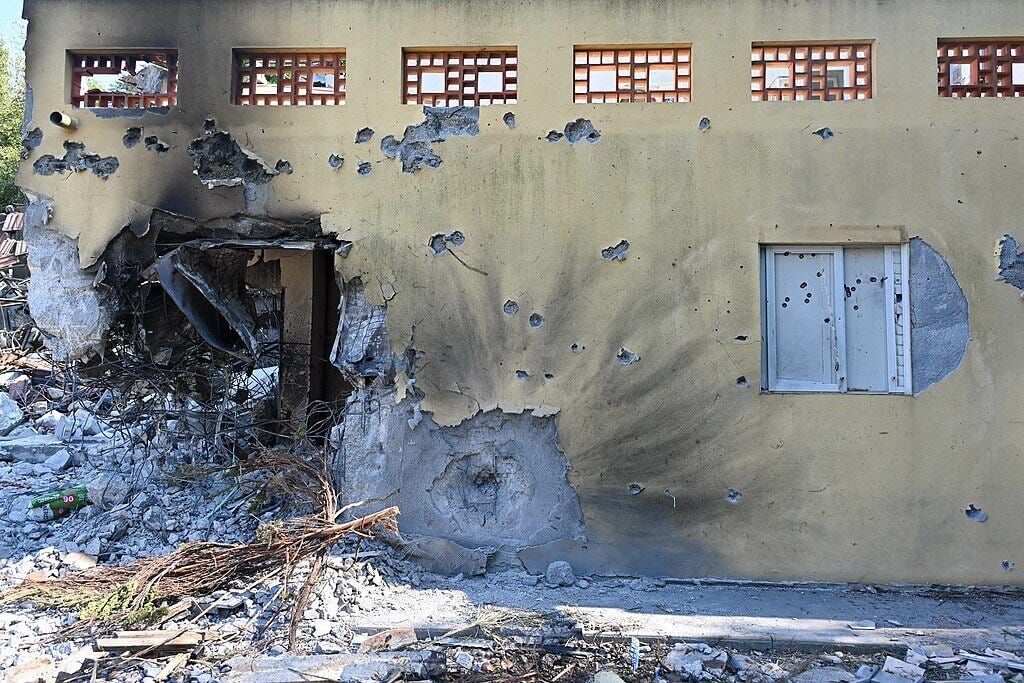
I’ve wondered for some time whether I should publish my notes written during the week of October 7, 2023. They were written in a small red book I carry with me, usually to record an observation, a reflection, or even just a sentence that might one day lead to an article.
The first of these notes was written the night of October 7 and the second on October 8, while the events were still unfolding and little was understood beyond what could be seen and felt.
They are rough notes, written quickly and intended for no audience other than myself. I have left them exactly as they were, resisting the temptation to improve a sentence, sharpen an observation, or repair a flaw. All the benefit of hindsight is therefore left wanting.
My intention is modest: to preserve something of those days before memory had the time to settle into a narrative. If they carry some meaning for others, then publishing them will have been worthwhile.
October 7: A Black Saturday
“For as long as I can remember, I remember fear. Existential fear.”
That is how Ari Shavit begins My Promised Land, reflecting on the outbreak of the Yom Kippur War on October 6, 1973. I first read those words as a teenager in South Africa. They struck me then as the inheritance of another generation. I could not have imagined that, fifty years and one day after that war began, I would discover, in the most intimate way, what Shavit meant.
It is no exaggeration to say that such fear entered my life this morning. It did not announce itself. It simply arrived, as though it had been waiting patiently for an ordinary day to surrender to catastrophe.
I am staying with friends now. Their apartment has a bomb shelter built into the bedroom, the consequence of Israeli law for newer buildings. My apartment, by contrast, was built in the 1960s, so the basement serves as the shelter. It has its charms, the sort of place people describe as having character. But character and security are different virtues, and only one of them matters when rockets are crossing the sky.
That is how the day began, with rockets. The sirens woke me. I have made the journey down those four flights of stairs to the basement many times. Arnon was there again, the six year old, from the first floor. We found a dusty, half-deflated ball in the corner and kicked it back and forth while explosions echoed somewhere above us. What a strange attempt at normality. He is a sweet kid.
I should add that the basement has a smell that is impossible to ignore. Damp concrete and something else. I have long suspected that the neighborhood cats slip inside at night. The smell of urine supports my theory. Put simply, it is not a place anyone would choose to begin the day. Wars, however, have a peculiar talent for making the least hospitable places feel indispensable.
After twenty minutes, there was the first sign of quiet. Friends living a few blocks away called to invite me over — the friends whose apartment has a proper bomb shelter — a safer place, and one without the smell of urine. Naturally, I accepted.
Then the sirens returned. I ran as fast as I could while explosions echoed overhead. White puffs of smoke bloomed across the sky, tracing the places where Iron Dome had done its work. I am not ashamed to admit that, standing outside at that moment, I found myself longing for the basement with its smell of urine.
After sheltering in a café for a few minutes, I continued on. Eitan and Tessa let me in. The rockets began again, while rumors started filtering in from the Gaza border. I remember the look on Tessa’s face as she showed me a clip of armed men wearing green headbands, riding in the back of a white pickup truck, firing into the streets of a town in the south.
Then another lull. “There aren’t enough supplies,” Eitan said. Normality, or something like it, returned as we walked to the supermarket. Outside I ran into a journalist friend from Haaretz. His estimate was that perhaps forty Hamas terrorists had crossed the border.
“Forty?” “I’ve only seen a video of about ten.” Neither of us could have imagined what we know tonight. Then another siren. Then the explosion. A rocket struck a building no more than a hundred meters away. I still think part of me is hiding in that stairwell we managed to reach.
Already sheltering there was a group of young men, a band from Sweden. They had played their final show the night before and were supposed to be flying home within hours. “Poor bastards”, I thought as we left.
Everything seemed to change at around 10 am. The rumours became confirmations. More and more videos arrived. People lying dead at a bus stop. The young running for their lives through the fields. I’m hearing they were at a music festival. If it is the same festival I’m thinking of, I know people there. I texted a few and have not heard back from them yet.
Phones kept passing from hand to hand, with images filmed by the killers themselves. “How many are dead?” “Hundreds”, “Possibly more….” “People are being taken into Gaza.” “Entire communities are under attack.”
The three of us hurried to another friend’s apartment. He had already been called up to the reserves. Not to the south, but to the north. There are fears that Hezbollah would join the war.
As I watched him button his uniform and pack his gear, the rockets receded into the background. I found myself thinking about something I had heard all my life: the promise that one day a great wave would rise from the surrounding darkness, from every front at once, and push us into the sea.
Is this it?
October 8: Because I’m not in America
Hezbollah opened a front this morning.
I find myself thinking about Gil, my friend, and the others I know in the north. And, of course, about the families now living under constant rocket fire. The news reports that entire villages have been emptied.
I am beginning to understand something about that fear today. The fear that, as Shavit wrote, I will remember for as long as I can remember.
It is the mind’s inability to absorb reality when reality arrives all at once. The gap between what is happening and what one can permit oneself to believe is happening. It is the strange sensation that the world has already changed, but that the change has not yet reached your own consciousness.
All of which is to say, that I do not know what has happened, but something has. Something that alters not only the future but the past. All I thought I understood suddenly appears in a different light. Assumptions I regarded as solid now seem absurd. Things will never be the same. Perhaps they never were what I imagined them to be.
A friend in New York sent me a video an hour ago of members of the DSA celebrating in the streets of the city that still carries the memory of September 11. I cannot pretend to be surprised. The massacre of Jews has long, for some, served as another reason to indict the Jews.
The only people more naïve than those who still believe in the mythology of the Palestinian revolution are those flooding social media with the refrain: “Context matters.”
These fools celebrate and they excuse while Hamas gunmen are still inside Israel. While families are still trapped in their homes. While the dead have not yet all been counted. And they celebrate the death of 700 Israeli civilians despite the fact that it was Gazan civilians who crossed the border behind the gunmen. I do not know precisely what crime each one committed. I only know they did not cross into Israel for afternoon tea.
So perhaps the fools are actually right. Perhaps context does matter. Here is some context.
Before yesterday, the deadliest attack on a Jewish community since the Holocaust was the bombing of the AMIA Jewish community centre in Buenos Aires in 1994. Eighty-five people were murdered. What had Argentine Jews done? Nothing. They died because Hezbollah and Iran decided that Jews thousands of miles away should pay for events in the Middle East. That is context.
In Mumbai, in 2008, Pakistani terrorists moved methodically through the city, selecting targets. One of those targets was a small Chabad House. Six Jews were murdered there. What connection did the Chabad have to Kashmir’s occupation? None. That is context.
I think of Toulouse. Of the children murdered outside the Otzar Hatorah school. Of the customers murdered at Hyper Cacher in Paris. French Jews, killed by French Islamists. What connection did they have to borders, settlements, or failed negotiations? None. That is context.
I think, too, of the words spray-painted onto a wall in Sea Point, the predominantly Jewish neighborhood in Cape Town where I lived before moving to Israel. “Holocaust 23.” That is context.
I think of Hebron in 1929. Sixty-seven Jews massacred. The largest massacre of Jews in this land up until yesterday. No occupation. No Gaza (the Jews of Gaza had by then been expelled by the Ottomans a decade earlier). No settlements. No State of Israel. What was the context then?
I think of the expulsion of the Jews of Yemen in 1679. Of Mashhad in 1839. Of the Farhud in Baghdad in 1941. The murders. The rapes. The forced conversions. The destruction of Jewish communities that had existed in the Arab world for centuries. That, too, is context.
And today I sit here trying to understand what happened yesterday. Trying and failing, mostly failing.
Because the story is still unfolding. Because people are still dying. Because there are hostages in Gaza. Because there is now war in both the north and the south. Because I know the dead.
Because I suspect that the war will only get worse, and that when all of this is over, we will discover that yesterday was even worse than we think.
Because I am not in America.
Thank you. This tore at my heart.
I think often about the just…arrogance of so many American Jews and how the only difference between us and Israelis is where our ancestors happened to immigrate to. That’s it. There is nothing morally superior about us, it is literally just chance. How can an American Jew look at an Israeli one and see one as an occupier deserving of war and death and destruction while they sit in their safe family home in the United States? I truly don’t understand it.